If you have walked into a stylish living room in 2026 and noticed a curved back, a polished wood frame and a deep buttoned silhouette staring back at you, you are not imagining it. The art deco sofa is back — and not as a costume piece. Architectural Digest named “Neo Deco” one of the defining trends of 2026, Pinterest predicted a sharp rise in deco-inspired searches, and House Beautiful confirmed the revival is in full swing on the British design scene. For interior designers, this is the most interesting statement sofa moment in a decade.
This guide is written for interior designers and design-led homeowners who want to specify an art deco sofa in a modern British living room without the room reading as a 1920s film set. It covers what is driving the 2026 Neo Deco revival, what actually defines an art deco sofa, the full Newman & Bright art deco sofa collection at a glance, how to choose the right piece for the room, how to style it in a contemporary interior, and a practical designer’s specification checklist. Whether you are sourcing for a Mayfair apartment, a converted Manchester warehouse or a Surrey country house, the principles below will help you make the most of this most sculptural of statements.
In This Guide
1. What’s Driving the 2026 Art Deco Sofa Revival
2. What Defines an Art Deco Sofa (and What Doesn’t)
3. The Newman & Bright Art Deco Sofa Collection — At a Glance
4. How to Choose the Right Art Deco Sofa for Your Room
5. Styling the Art Deco Sofa in a 2026 Interior
6. Art Deco Sofa vs Other Statement Sofas — At a Glance
7. The Designer’s Specification Checklist
8. Frequently Asked Questions
What’s Driving the 2026 Art Deco Sofa Revival
Every decade or so, the art deco sofa comes back. It happened in the 1960s, when the original deco generation started being rediscovered by a new wave of collectors. It happened again in the 1980s, when Memphis and postmodernism pushed designers back towards geometric form. And it is happening now, in 2026, for a different and more durable reason: the modern British interior has become minimalist enough that a sculptural piece of furniture is the most efficient way to give it character.
Architectural Digest named “Neo Deco” the designer-approved trend of 2026, citing a return to rich materials, glossy finishes, colour-drenched walls and a deliberate embrace of what they called “the dark side.” Pinterest named Neo Deco in its 2026 trend predictions, pointing to marked increases in searches for red marble, fluted glass, sunburst mirrors and curved velvet furniture. House Beautiful UK confirmed the trend is landing on British shores, with a clear twist: the new art deco interior is louder, bolder and more saturated than the version that came before.
For interior designers, the practical implication is that an art deco sofa is no longer a niche specification. It is a trending silhouette, supported by a wave of editorial coverage and search interest, and the designer who can specify it well in a contemporary room will be ahead of the curve. The pieces that work in 2026 are not the dark, formal, gentlemen’s-club deco sofas of the 1990s — they are lighter, curvier, more sculptural, and specified in fabrics that read as contemporary. The art deco sofa has been reinterpreted for the modern British interior, and the result is one of the most exciting statement furniture moments of the decade.
What Defines an Art Deco Sofa (and What Doesn’t)
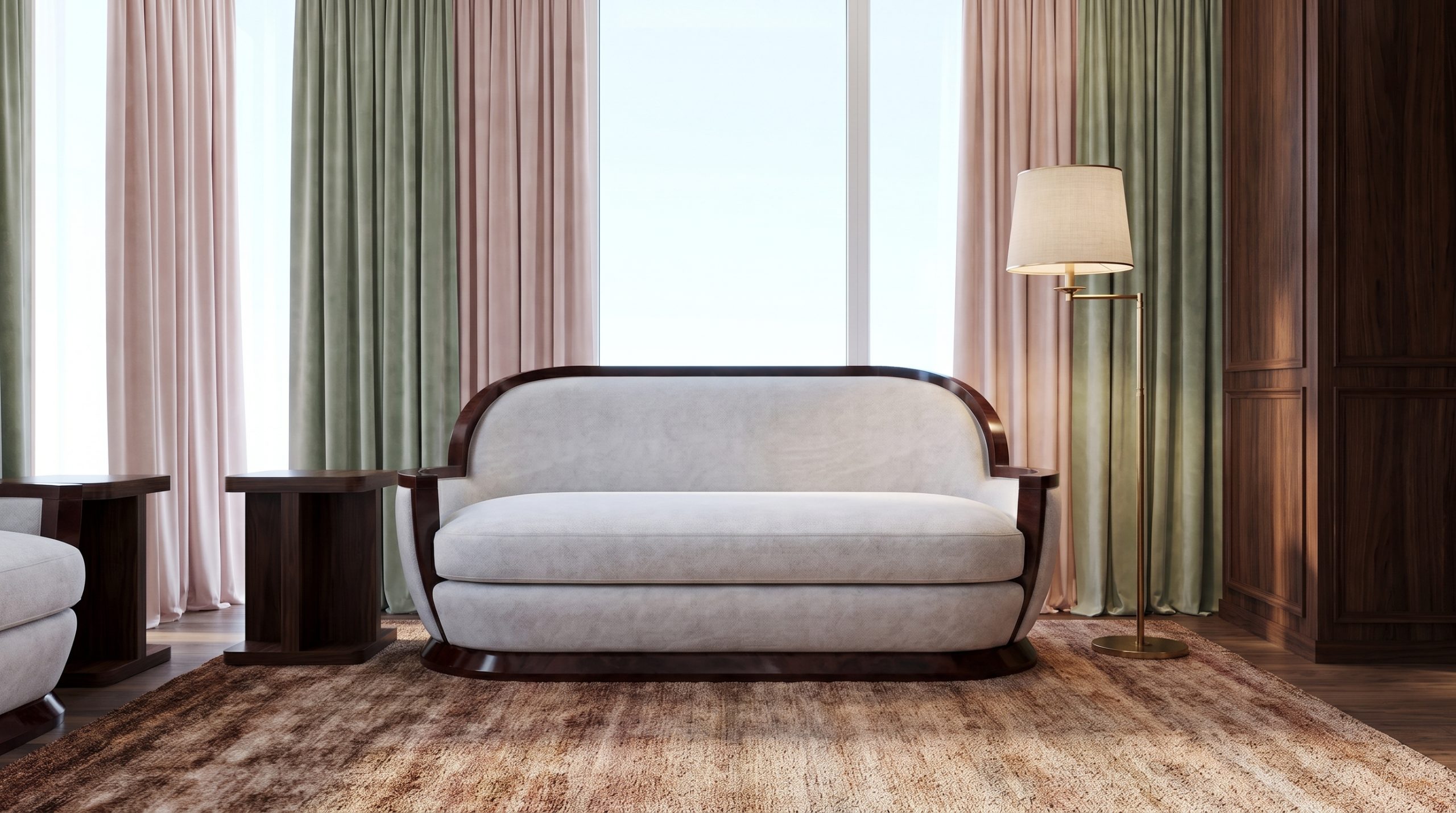
The art deco sofa is a specific form, not a mood. It is defined by a set of construction and silhouette conventions that emerged in the 1920s and were refined through the 1930s, and a designer who can identify those conventions can specify the piece with confidence. The defining features are: a curved or geometric back that follows a single sweep rather than a separate cushion; arms that scroll, curve or step in a geometric pattern; deep buttoning or tufting, often in a sunburst or fan motif; and, in many cases, an exposed polished wood frame along the arms, back or legs.
What does not define an art deco sofa: any sofa with a velvet cover, any sofa with a curved arm, any sofa with a buttoned back. A velvet chesterfield is not an art deco sofa. A mid-century curved sofa is not an art deco sofa. A buttoned-back contemporary designer sofa is not an art deco sofa. The art deco sofa is a specific silhouette with a specific lineage, and the distinction matters because the silhouette is what gives the piece its sculptural authority in a modern room. A velvet chesterfield reads as traditional British. An art deco sofa reads as 1920s glamour. The difference is the form, not the fabric.
Within the art deco sofa tradition, there is a useful distinction between two sub-types. The Gatsby form — named, inevitably, for the F. Scott Fitzgerald character — is the more traditional: curved back, scroll arms, deep buttoning, optionally with an exposed show-wood frame. The Garbo form, named for the 1930s Hollywood actress, is sleeker and lower, with less buttoning and more line: it reads as the more contemporary of the two and is often the easier piece to specify in a modern British interior. Both are legitimate art deco sofas; the choice between them is a matter of room and client.
The Newman & Bright Art Deco Sofa Collection — At a Glance
Newman & Bright has been making art deco sofas in Worsley since the 1920s — the workshop was already established when the form was first being defined. The current Art Deco collection spans seventeen pieces, from the signature Gatsby through to sculptural crescents, low-slung cloud forms, and a curved accent chair. The table below summarises the collection across silhouette and ideal room, to help designers shortlist the right piece for a project before coming into the showroom.
Table 1. The Newman & Bright art deco sofa collection — silhouette and ideal room by model
| Art Deco Sofa Model | Silhouette & Defining Features | Ideal Room |
| Gatsby Art Deco Sofa | The signature piece. Curved back, scroll arms, deep buttoning. The reference art deco sofa. | Formal living room, statement drawing room |
| Gatsby Show-Wood Art Deco Sofa | Gatsby silhouette with exposed polished wood frame. Combined deco and showwood traditions. | Period living room, wood-panelled interior |
| Gatsby Tiffany Art Deco Sofa | Gatsby form with Tiffany-style curved arms. More sculptural, softer deco. | Curved-wall room, contemporary deco interior |
| The Garbo Art Deco Sofa | Sleek, low, curved silhouette inspired by 1930s Hollywood. Less buttoning, more line. | Modern loft, contemporary apartment, bedroom |
| The Carnegie Art Deco Sofa | Architectural, geometric, structured. The most overtly deco silhouette in the collection. | Statement living room, gallery interior |
| Opera Art Deco Sofa | Dramatic curved form, theatrical scale. The piece for a grand room. | Grand entrance hall, double-aspect living room |
| Retro Art Deco Sofa | Streamlined, simplified deco. Easier to specify in contemporary interiors. | Modern British living room, new-build |
| Retro Wood Art Deco Sofa | Retro form with exposed wood frame. Warmer, transitional. | Family room, country-house interior |
| The Charleston Art Deco Sofa | Curved, playful, 1920s dance-hall inspired. Lighter in feel than the Gatsby. | Bedroom sitting area, garden room |
| The Tulip Art Deco Sofa | Curved tulip-arm silhouette, feminine, sculptural. | Boutique hotel, feminine drawing room |
| The Crescent Art Deco Couch | Full crescent form, sculptural. Designed to float in a room. | Open-plan living room, sculptural statement |
| The Cloud Art Deco Couch | Soft, oversized, low-slung deco. Comfort-led take on the silhouette. | Family room, relaxed living space |
| The Orleans Art Deco Sofa | Classic French deco form, curved arms, tight back. | Parisian-style interior, formal living room |
| Montrose Art Deco Sofa | Structured, tailored, low-back deco. Reads as contemporary. | Modern British interior, architect-led space |
| Hatfield Art Deco Sofa | Country-house deco, slightly more traditional. | Period country property, heritage interior |
| The Step Art Deco Bench | Bench form, stepped deco detailing. Less | Hallway, entrance, statement |
NEWMAN & BRIGHT Art Deco Sofa Styling Guide / October 2026
| Art Deco Sofa Model | Silhouette & Defining Features | Ideal Room |
| Sofa | formal, more architectural. | bench |
| The Cocoa Art Deco Accent Chair | Accent chair form of the collection. Curved, compact, sculptural. | Bedroom, reading corner, dressing room |
Read the table by room type first, then by silhouette. A formal living room has the widest choice — the Gatsby, Carnegie, Opera and Orleans all work — because a formal room has the architectural presence to carry a strong deco silhouette. A modern British living room, particularly a new-build, will be better served by the Retro, Retro Wood or Montrose forms, which simplify the deco vocabulary for a contemporary eye. The Garbo, Charleston and Tulip sit between the two: sculptural enough to read as deco, restrained enough to read as modern.
How to Choose the Right Art Deco Sofa for Your Room
Once the shortlist is drawn, the choice between specific art deco sofa models comes down to four questions: the architecture of the room, the proportions of the space, the light, and the client’s aesthetic. Each of these will rule certain pieces in or out before you ever get to fabric.
Architecture: Period or Contemporary?
In a period room — a 1920s or 1930s property, a converted hotel, a building with original art deco architectural detail — the Gatsby or Gatsby Show-Wood is almost always the right answer, because the architecture will already be speaking the same language. In a contemporary room, the Garbo, Retro or Montrose is usually a better fit, because their simplified silhouettes give the deco reference without competing with the architecture. The Carnegie is the most overtly deco piece in the collection and works best in a room that can hold its own against it — a double-aspect living room, a gallery-style interior, a statement entrance hall.
Proportions: Float or Wall?
An art deco sofa with a curved back — the Gatsby, Garbo, Charleston, Crescent — is designed to be seen from multiple angles and is the ideal piece to float in the middle of a room. A linear art deco sofa — the Carnegie, Montrose, Hatfield — sits more happily against a wall, where its architectural silhouette can be read in elevation. The Crescent is the collection’s sculptural statement: a full curve designed to float in the centre of a room and be walked around. It is the wrong piece for a wall placement and the right piece for an open-plan space.
Light: North or South?
An art deco sofa in velvet needs natural light to look its best — the pile flattens in shadow and the colour reads muddy in north light. If the room is north-facing or under-lit, specify the art deco sofa in leather, mohair or a flat-weave linen instead. Velvet in a south-facing room will look exactly as it should: rich, sculptural, the surface catching the light. This is the single most common specifying mistake with art deco sofas, and it is the easiest to avoid.
Client Aesthetic: Bold or Quiet?
Some clients want the art deco sofa to be the room. Others want it to be a quiet reference in a larger scheme. For the first client, the Carnegie, Opera or Crescent in a saturated velvet is the answer. For the second, the Retro, Garbo or Montrose in a soft neutral is the answer. The collection is wide enough to support both aesthetics; the designer’s job is to identify which client is which before the fabric conversation begins.
Styling the Art Deco Sofa in a 2026 Interior

Specifying the art deco sofa is half the work. Styling it is the other half — and on this, the 2026 Neo Deco trend is unequivocal. The pieces that look current in 2026 are styled with restraint, contrast and a deliberate nod to contemporary material. The pieces that look dated are styled as period reproductions, with matching deco accessories, symmetrical arrangements and a velvet-on-velvet-on-velvet scheme. The difference is editing.
Fabric Direction for 2026
The Neo Deco trend favours rich, saturated colour and tactile pile. Velvet remains the strongest fabric choice for an art deco sofa in 2026 — particularly in emerald, oxblood, petrol blue, ochre and warm putty — but mohair and linen blends are gaining ground for designers who want the silhouette without the formality. Avoid high-shine fabrics, which push the piece back towards 1980s nostalgia. Avoid brown leather, which reads as traditional rather than deco. The art deco sofa in a deep emerald velvet against a colour-drenched wall is the defining image of 2026 British interior design.
Placement: Float, Don’t Push Back
The deco silhouette is sculptural, and sculptural pieces are wasted against a wall. If the room allows, float the art deco sofa in the middle of the space and use the curve of the back as a visual divider between zones. Anchor with a generous rug — at least 30cm of rug extending beyond the front legs — and use the back of the sofa as a console surface, with a pair of lamps behind it. In smaller rooms, against-the-wall placement is correct, but pair the sofa with a single overscaled piece of art to keep the wall from reading as flat.
Lighting the Sculptural Form
An art deco sofa is a three-dimensional sculptural object, and it needs to be lit as one. Three layers, as with any statement sofa: ambient (dimmed ceiling), task (a floor lamp beside the sofa for reading) and accent (a table lamp on a console behind the sofa, throwing light up into the buttoning). The accent layer is non-negotiable for an art deco sofa — without it, the buttoning disappears into shadow and the sculptural form is lost. Brass or blackened-steel lamp fittings echo the deco period without being literal about it.
Pairing with Contemporary Pieces
The most successful 2026 art deco sofa schemes pair the sculptural heritage piece with deliberately contemporary surroundings. A mid-century lounge chair in walnut and leather. A sculptural glass-and-brass coffee table. A large-scale abstract painting rather than a deco-era print. The rule is: one deco reference per room. Two deco references start to read as a period pastiche; three or more read as a film set. The art deco sofa is the statement. Let it be the statement.
Art Deco Sofa vs Other Statement Sofas — At a Glance
Designers are often asked why an art deco sofa should be the statement piece rather than a chesterfield, a mid-century modern piece, a modular corner unit or a contemporary designer sofa. The honest answer is that each has its place — but the art deco sofa is the only one that brings both sculptural silhouette and a current trend tailwind to a room. The table below summarises how the five most common statement sofa types compare across the criteria that matter most on a real project.
Table 2. Art deco sofa compared with four other statement sofa types
| Sofa Type | Silhouette | Best For | Designer Notes |
| Art Deco Sofa | Curved back, scroll or geometric arms, deep buttoning, polished wood frame option. | Period interiors, contemporary Neo Deco schemes, statement living rooms | Most sculptural statement piece. Reads as curated antique in modern rooms. |
| Chesterfield Sofa | Low rolled arms, deep buttoning, fully upholstered silhouette. | Period townhouses, formal living rooms, traditional British interiors | More horizontal, more traditional. Pair with art deco accent chairs for hybrid schemes. |
| Mid-Century Modern | Low, slimline, splayed legs. Visual lightness. | 1960s properties, scandi schemes, apartments | Visually quieter. Works as a counterpoint to a sculptural art deco sofa. |
| Modular Corner | Generous L or U shape. Ground-hugging. | Open-plan family rooms, basements | Function-led, not silhouette-led. Not a substitute for an art deco sofa. |
| Contemporary Designer | Sculptural, often asymmetric. Often a single bold form. | Architect-led new-builds, gallery interiors | Strong statement but lacks the heritage narrative of the art deco form. |
Read across the row that matches the project. If the room needs a sculptural statement with a heritage narrative and a 2026 trend tailwind, the art deco sofa is the answer. If the room needs horizontal grounding and craft heritage, the chesterfield is the answer. In our experience, the most successful modern British living rooms pair an art deco sofa as the centrepiece with one quieter secondary sofa type — not two art deco sofas in the same space. Two deco silhouettes fight each other; the eye cannot settle.
The Designer’s Specification Checklist
Before specifying an art deco sofa for any project, run through this list with the client. It covers the practical questions that catch designers out between sign-off and delivery, and it doubles as a useful client-facing document for managing expectations on lead time, access and aftercare.
1. Measure the room twice — including doorways, stairs and lift access for delivery. An art deco sofa is a single rigid piece.
2. Confirm ceiling height. Art deco sofas often have curved backs that need vertical clearance to read properly.
3. Decide between Gatsby-form (traditional deco) and Garbo-form (contemporary deco) based on the architecture.
4. Choose fabric based on the room’s natural light. Velvet needs south light; leather and linen work in north light.
5. Swatch fabric in the actual room — never specify an art deco sofa from a screen.
6. Confirm the seat depth suits the client’s height and seating style (lounge vs upright).
7. Decide whether to specify a show-wood frame — the polished wood detail is a defining deco feature.
8. Verify the workshop offers hand-tied springs and hardwood frame construction.
9. Plan the lighting — the accent layer behind the sofa is non-negotiable for an art deco silhouette.
10. Ask about lead times — bespoke British-made art deco sofas typically run 8–12 weeks.
Frequently Asked Questions
Q. Is an art deco sofa a good choice for a modern living room?
Yes — and the 2026 Neo Deco trend is built on exactly this contrast. An art deco sofa specified in a contemporary fabric, paired with modern furniture and styled with restraint, reads as a sculptural statement rather than a period piece. The trend coverage from Architectural Digest, Pinterest and House Beautiful UK has firmly established the art deco sofa as a current silhouette for modern British interiors, not a nostalgic one.
Q. What is the difference between an art deco sofa and a chesterfield sofa?
A chesterfield sofa is fully upholstered, with low rolled arms, deep buttoning and a horizontal silhouette. An art deco sofa typically has a curved back, an exposed polished wood frame option, and a more geometric, sculptural silhouette. Both are traditional British forms, and both are made by Newman & Bright — but the chesterfield reads as traditional British, while the art deco sofa reads as 1920s glamour. The two can be paired in the same room if specified carefully, but two art deco sofas in the same space will fight each other.
Q. What fabric is best for an art deco sofa?
Velvet is the traditional art deco sofa fabric and remains the strongest choice for 2026, particularly in emerald, oxblood, petrol blue, ochre and warm putty. The pile catches the light and reads as sculptural. For contemporary schemes, mohair or a linen-velvet blend gives the silhouette without the formality. Avoid high-shine fabrics, which push the piece towards 1980s nostalgia, and avoid brown leather, which reads as traditional rather than deco.
Q. How long does a bespoke art deco sofa take to make?
A handcrafted art deco sofa from a British workshop such as Newman & Bright typically takes 8–12 weeks from approval of drawings and fabric to delivery. Lead times can extend in peak periods, so designers should factor this into the project programme from the outset and communicate it clearly to the client.
Q. Can an art deco sofa work in a small living room?
Yes, if specified carefully. Choose a low-back, curved form like the Garbo or Charleston rather than the higher-back Gatsby or Carnegie. Select a fabric that blends tonally with the walls to soften the silhouette, and float the sofa or place it against the wall with a tight 5cm gap to allow the curved back to breathe. The art deco sofa’s curved form is actually easier to specify in a small room than a chesterfield, because the curve softens the visual weight.
Q. What is Neo Deco?
Neo Deco is the 2026 interior design trend that reimagines 1920s art deco for contemporary homes. Architectural Digest named it a defining trend of 2026, Pinterest predicted it in their annual trend report, and House Beautiful UK confirmed the revival is landing in British interiors. The look favours rich materials, saturated colour, glossy finishes and sculptural silhouettes — of which the art deco sofa is the defining furniture piece.
An art deco sofa is one of the few pieces of furniture that can change the architecture of a room simply by being placed in it. The curved back, the sculptural silhouette, the polished wood frame — these are forms that draw the eye and hold it, and they give a modern British interior an instant point of view. With the 2026 Neo Deco trend firmly established, the art deco sofa is no longer a niche specification; it is one of the most current and editorial silhouettes a designer can specify. The pieces made in our Worsley workshop today will, like the Gatsby showwood we reupholstered last month after 29 years, still be the centre of someone’s living room in 2055.
If you are specifying an art deco sofa for a current project, the most useful next step is to come into the Worsley showroom with your room plans. We will walk you through the seventeen-piece collection, talk through the bespoke adjustments that will make the piece work for your specific room, and give you an honest lead time so you can programme it properly. Our workshop has been making bespoke British furniture since 1897. We are happy to share what we have learned.