Every interior designer has had the conversation. The client has fallen in love with a sofa in a catalogue, or been seduced by a high-street advertisement, and now they want to know why they should pay three or four times as much for a bespoke sofa from a British workshop when the mass-produced piece looks, to their eye, almost identical. It is a reasonable question. It deserves a better answer than “you get what you pay for.”
This guide is that answer. It is written for interior designers who need to articulate the difference between a bespoke sofa and a mass-produced one — not in marketing language, but in the construction, longevity and cost-per-year terms that clients actually understand. We have been making bespoke sofas in Worsley since 1897, and we have spent the last three decades watching the British furniture market split into two camps: a small number of workshops still making handcrafted pieces built to last decades, and a much larger number of brands sourcing flat-packed, factory-assembled sofas designed to last five to eight years. Both have a place in the market. They are not, however, the same product, and the difference is not just price.
In This Guide
1. What “Bespoke” Actually Means (and What It Doesn’t)
2. Frame, Springs, Fillings: The Construction Comparison
3. Bespoke Sofa vs Mass-Produced — At a Glance
4. The 25-Year Test: Why Lifespan Changes the Maths
5. The True Cost-per-Year Calculation
6. When a Mass-Produced Sofa Is the Right Answer
7. When a Bespoke Sofa Is the Only Sensible Answer
8. The Designer’s Specification Checklist
9. Frequently Asked Questions
What “Bespoke” Actually Means (and What It Doesn’t)
The word “bespoke” has been so thoroughly co-opted by marketing departments that it has almost lost its meaning. A quick clarification, because the distinction matters. A bespoke sofa is one where every dimension and construction detail can be specified to the project — seat depth, back height, arm width, cushion fill, leg finish, fabric, buttoning pattern. The piece is built to order, from raw materials, by craftspeople in a workshop. Nothing about it exists until you specify it.
Made-to-order is different. A made-to-order sofa is a fixed design, produced in your fabric choice. The dimensions don’t change. The construction doesn’t change. You are choosing from an existing pattern, not commissioning a new one. Made-to-order is a perfectly good option for many projects, but it is not the same thing as bespoke, and the price should reflect that.
Mass-produced is the third category — sofas built in volume, in standard sizes, to a fixed specification, often flat-packed for shipping. These are the sofas you see in catalogue showrooms and on high-street retail floors. They are designed for affordability and speed of delivery, not for longevity. The construction methods reflect that. So does the price.
Frame, Springs, Fillings: The Construction Comparison
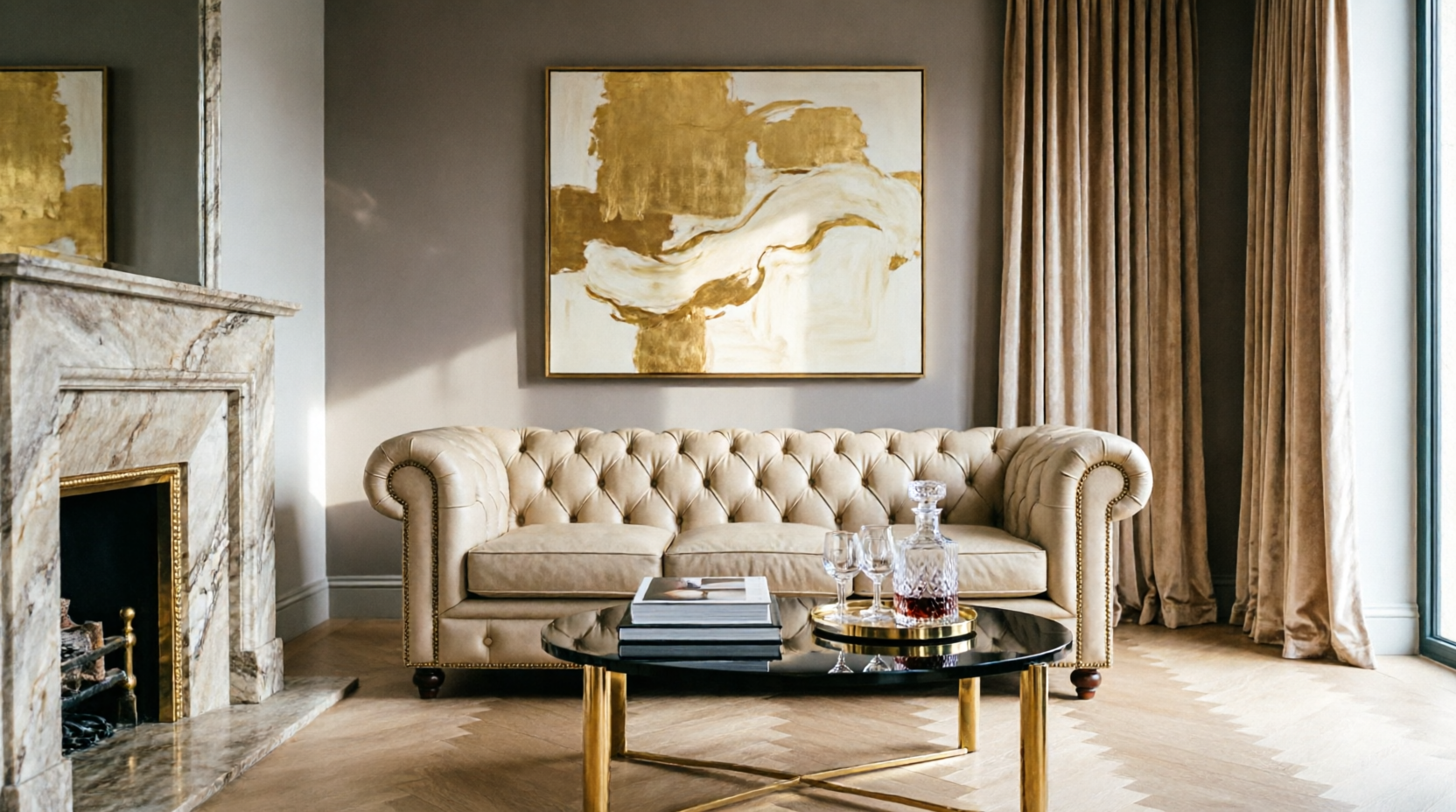
The differences between a bespoke sofa and a mass-produced one are not visible from the outside — which is exactly why clients struggle to justify the price gap. The differences live inside the sofa, in three components that determine how it will feel in five years, ten years, and twenty-five years.
The Frame
A bespoke sofa from a British workshop will almost always use a kiln-dried hardwood frame — typically beech, birch or ash — with mortise-and-tenon joints that are glued and dowelled by hand. The frame is the skeleton of the sofa; everything else is built onto it. A hardwood frame, properly jointed, will outlast every other component and is the single biggest reason a bespoke sofa can be reupholstered rather than replaced.
Mass-produced sofas, by contrast, typically use kiln-dried pine, particle board or MDF frames, joined with staples and screws. These frames are perfectly adequate for the first three to five years — they pass the same initial load tests as hardwood frames — but they do not age well. Pine warps. MDF swells. Stapled joints work loose. By year eight, the frame is often the reason the sofa has to go, even if the upholstery still looks serviceable.
The Springs
This is where the difference becomes most obvious to the sitter. A bespoke sofa uses hand-tied coil springs — each spring individually tied to its neighbours in eight directions, anchored to the frame, and tuned to the seat. The result is a seat that responds independently to pressure, distributes weight evenly, and retains its support for decades. Hand-tying springs is a skill that takes years to learn, which is why it is one of the first things mass-produced manufacturers cut.
Mass-produced sofas almost universally use serpentine (also called no-sag or zig-zag) springs — lengths of wire bent into a zig-zag pattern and clipped to the frame. They are fast to install, cheap, and perfectly acceptable for a sofa that will be replaced in five years. They are not, however, repairable, and they sag noticeably after three to four years of daily use.
The Fillings
A bespoke sofa will typically use a layered filling — a high-density foam core wrapped in feather, fibre or down, in a removable cover. The cushion can be restuffed, replumped, and re-covered without replacing the sofa. The fill can be specified to the client’s preferred firmness — something mass-produced manufacturers do not offer.
Mass-produced sofas use a single-density foam cushion, glued to a fixed cover. The foam compresses over time and cannot be restuffed without dismantling the entire cushion. When the foam goes — typically at year five to seven — the cushion goes, and usually the sofa goes with it.
Bespoke Sofa vs Mass-Produced — At a Glance
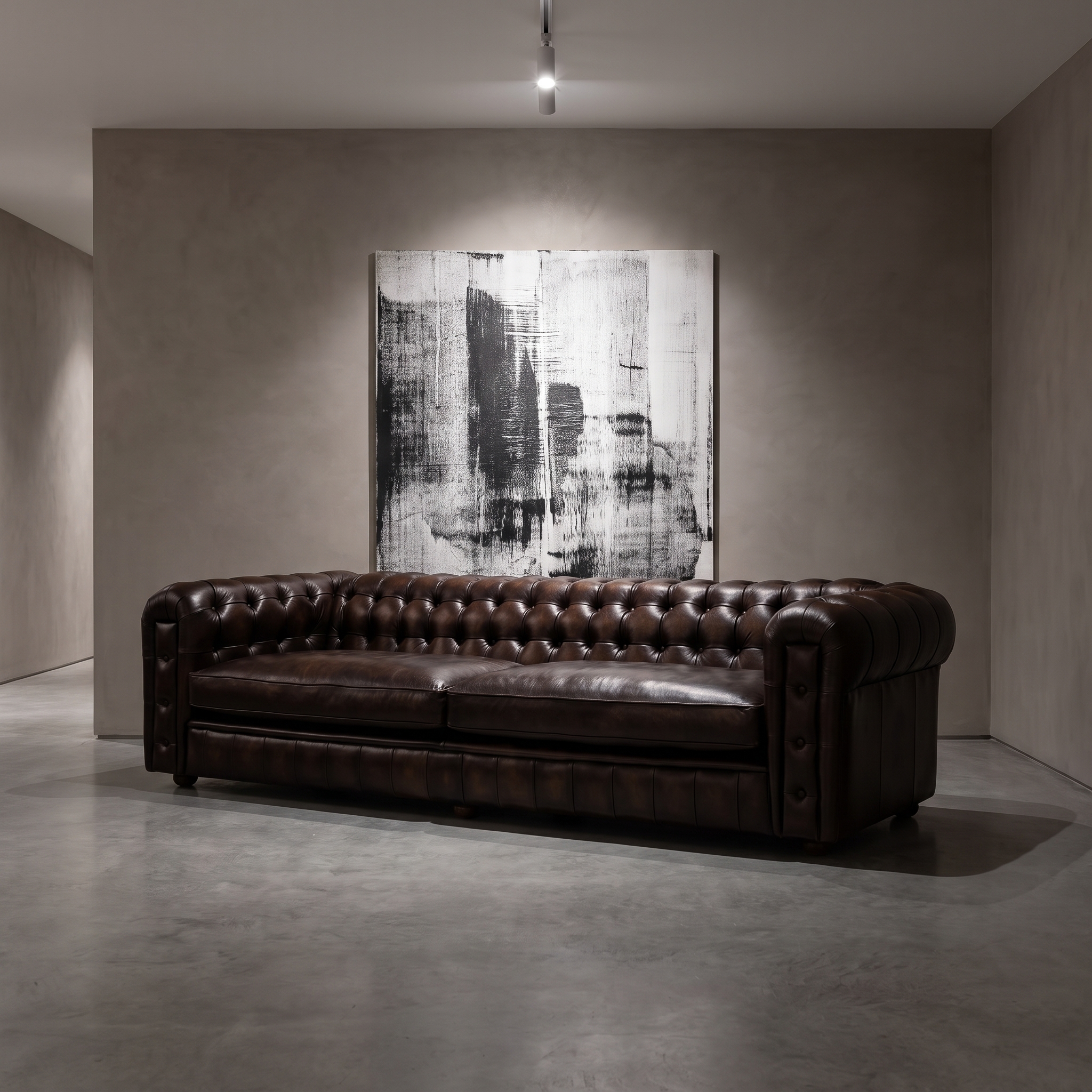
The table below summarises the construction differences across the nine criteria that most affect lifespan, comfort and total cost of ownership. Read across each row: where the bespoke sofa offers a feature, the mass-produced sofa offers a substitute, and the substitute is almost always engineered for cost rather than longevity.
Table 1. Bespoke sofa vs mass-produced sofa — component-by-component comparison
| Comparison | Bespoke Sofa (N&B workshop) | Mass-Produced Sofa (catalogue brand) |
| Frame | Hardwood beech frame, hand-jointed and glued. 25-year structural guarantee. | Kiln-dried pine or MDF, stapled and screwed. 1–5 year guarantee. |
| Springs | Hand-tied coil springs, eight-way tied. Each spring individually anchored. | Serpentine (zig-zag) springs clipped to frame. No individual tying. |
| Seat fillings | Layered feather and high-density foam, restuffable. Cushions recoverable. | Foam-only cushion, fixed cover. Replacement often means a new sofa. |
| Fabric | Tailored to the room. Curated velvet, leather, linen and wool libraries. | 5–15 fabric options per model. Cut to standard pattern. |
| Dimensions | Seat depth, back height, arm width all specified to the project. | Fixed sizes — typically 2-seater / 3-seater only. |
| Lead time | 8–12 weeks from approval. Made-to-order in the UK. | Stock or 2–4 weeks. Often imported flat-packed. |
| Repairability | Re-upholstery, re-stuffing, frame repair — all possible at the workshop. | Generally not repairable. Damage means replacement. |
| Expected lifespan | 25–40+ years with re-upholstery. | 5–8 years before replacement. |
| Cost-per-year (approx) | £30–£60 per year over 25 years. | £75–£150 per year over 5–8 years. |
The pattern is consistent. Every component in a bespoke sofa is designed to be repaired, restuffed or reupholstered. Every component in a mass-produced sofa is designed to be replaced. This is not a difference of quality; it is a difference of philosophy — and the philosophy has a cost implication that plays out over decades, not months.
The 25-Year Test: Why Lifespan Changes the Maths
The most useful question a designer can ask a client who is wavering on price is this: “Where do you expect this sofa to be in 25 years?” The answer, for a mass-produced sofa, is “in a landfill.” The answer, for a bespoke sofa, is “still in your living room — possibly reupholstered, almost certainly still structurally sound, and probably looking better than it did at year one.”
This is not a marketing claim. It is a function of how the two products are built. A hardwood frame does not wear out. Hand-tied springs do not sag. Layered fillings can be restuffed. A fixed cover can be replaced. Every component of a bespoke sofa is, in engineering terms, serviceable — which means the sofa itself is serviceable, indefinitely, with periodic intervention.
A mass-produced sofa, by contrast, is engineered as a single disposable unit. When the foam goes, the cushion cannot be restuffed. When the frame warps, the sofa cannot be reupholstered. When the serpentine springs sag, they cannot be retied. The piece is designed, from the ground up, to be replaced — and the client pays for that replacement every five to eight years, usually without quite realising they are doing it.
The True Cost-per-Year Calculation
This is the calculation that closes the conversation. Take the upfront cost of the sofa, divide it by the number of years it will realistically last, and you get the cost-per-year — the only honest metric for comparing furniture at different price points. The numbers below are illustrative, but they reflect what we see in the workshop and what our trade clients report from their projects.
Table 2. Cost-per-year comparison — bespoke vs mid-range vs budget catalogue sofa
| Scenario | Upfront cost | Lifespan | Cost per year |
| Bespoke N&B sofa, 25-year lifespan | £3,500 | 25 years | £140 / year |
| Mid-range catalogue sofa, replaced x3 | £1,200 | 5 years | £240 / year |
| Budget catalogue sofa, replaced x5 | £600 | 4 years | £150 / year |
Read the right-hand column. A bespoke sofa at £3,500, lasting 25 years, costs £140 per year. A mid-range catalogue sofa at £1,200, replaced three times over the same period, costs £240 per year. A budget catalogue sofa at £600, replaced five times, costs £150 per year. The bespoke sofa is, in cost-per-year terms, the cheapest of the three — and that calculation does not include the cost of disposal, the cost of choosing a new sofa each time, or the environmental cost of throwing away five sofas instead of buying one.
For interior designers, this calculation is the single most useful client-facing tool in the bespoke-versus-mass-produced conversation. It reframes the decision from an emotional one (“this sofa costs more”) to a rational one (“this sofa costs less per year of use”), and it gives the client a piece of arithmetic they can carry into every future furniture decision.
When a Mass-Produced Sofa Is the Right Answer
It would be dishonest to pretend bespoke is always the right call. There are projects where a mass-produced sofa is the correct specification, and a good designer should be able to identify them without embarrassment.
Short-term lets and holiday homes, where the sofa will see heavy use from unfamiliar occupants and may not be in service long enough to amortise a bespoke piece. Staging projects, where the sofa is a prop, not a piece of lived-with furniture. Budget-constrained first-time buyer projects where the client knows they will move within five years and wants something presentable rather than permanent. Any project where the sofa’s primary function is aesthetic, not structural — a TV room sofa that will be replaced when the children are older, a hallway bench sofa that sees only occasional use.
In each of these cases, a mass-produced sofa is the right answer because the lifespan of the use case matches the lifespan of the product. The mistake is not specifying mass-produced; the mistake is specifying mass-produced for a use case that needs bespoke, and pretending the maths will work out. It will not.
Conversely, there are projects where specifying a mass-produced sofa is a disservice to the client — regardless of budget. The family living room of a forever home, where the sofa will see daily use for twenty years. The formal living room of a period property, where standard dimensions will not fit the architecture. Any project where the client has invested in bespoke joinery, fitted cabinetry or architectural restoration — a mass-produced sofa in that context will read, immediately, as the thing that lets the room down.
There is also a category of project where bespoke is the only answer for ethical reasons. Clients who care about provenance, about British manufacturing, about the environmental cost of disposable furniture, about the people who made the thing they sit on — these clients are not going to be satisfied by a mass-produced sofa, however well-marketed. They want to know the name of the workshop. They want to know the craftspeople. They want to know that the frame is hardwood, the springs are hand-tied, and the piece can be returned to the workshop in fifteen years for a refresh. A mass-produced sofa cannot answer any of those questions.
The Designer’s Specification Checklist
Before specifying either a bespoke sofa or a mass-produced sofa for a project, run through this list with the client. It clarifies the brief, exposes assumptions, and — importantly — creates a documented record of the decision-making process that you can refer back to if the client later questions the recommendation.
1. How long does the client realistically expect to keep this sofa? (Under 5 years = mass-produced acceptable; 10+ years = bespoke strongly advised.)
2. Is the room a standard shape, or does it need non-standard dimensions? (Non-standard = bespoke.)
3. Will the sofa see daily family use, or occasional formal use? (Daily family = bespoke springs and fillings.)
4. Does the client have pets, children, or specific fabric performance needs? (Bespoke fabric specification.)
5. What is the room’s ceiling height and sightline? (Low ceilings may need a bespoke low-back.)
6. Will the sofa fit through doorways and up stairs on delivery? (Bespoke can be engineered for access; mass-produced cannot.)
7. What is the client’s position on British manufacturing, provenance and environmental impact?
8. Does the client want to specify a fabric outside the catalogue range? (Bespoke only.)
9. Has the client been shown the cost-per-year calculation? (They should be, before any decision.)
10. What is the project programme? (Bespoke needs 8–12 weeks lead time built in.)
Frequently Asked Questions
Q. Is a bespoke sofa worth the money?
In cost-per-year terms, almost always. A bespoke sofa at £3,500 lasting 25 years costs £140 per year. A mid-range catalogue sofa at £1,200, replaced three times over the same period, costs £240 per year. The bespoke sofa is the cheaper option, by some distance, when you measure cost over the life of the piece rather than at the point of purchase. The arithmetic gets more favourable the longer the client expects to keep the sofa.
Q. How long does a bespoke sofa last?
A well-made bespoke sofa with a hardwood frame, hand-tied springs and layered fillings will last 25 to 40 years — longer, with periodic reupholstery. The frame is the limiting factor; everything else can be serviced. At Newman & Bright we regularly reupholster pieces we made in the 1990s, and we occasionally see frames from the 1960s and 1970s that are still structurally sound. A mass-produced sofa, by contrast, typically reaches end-of-life at five to eight years.
Q. What is the difference between bespoke and made-to-order?
Bespoke means every dimension and construction detail can be specified to the project — seat depth, back height, arm width, cushion fill, leg finish, fabric. Nothing exists until you specify it. Made-to-order means a fixed design is produced in your fabric choice; the dimensions and construction do not change. Made-to-order is a good option for many projects, but it is not the same as bespoke, and the price should reflect that. If a supplier is calling their product “bespoke” but only offering fabric choice, the word is being used as marketing, not as a description.
Q. Can a mass-produced sofa be reupholstered?
Rarely, and usually not economically. Mass-produced sofas typically use stapled pine or MDF frames and serpentine springs — neither of which survives the stripping process that reupholstery requires. Even if the frame survives, the cost of reupholstering a mass-produced sofa is often close to the cost of replacing it, which is why most upholsterers will decline the job or quote a price that makes replacement the rational choice. Bespoke sofas, by contrast, are designed to be reupholstered and can be returned to the workshop multiple times over their lifespan.
Q. Why do bespoke sofas take 8–12 weeks to make?
Each bespoke sofa is built to order, in sequence, by craftspeople. The frame is jointed and glued, then left to cure. The springs are hand-tied, which takes a full day for a three-seater. The fillings are layered and shaped by hand. The fabric is cut, pattern-matched and hand-stitched. The buttoning —if specified — is pulled individually, by hand, hundreds of times. None of these steps can be rushed without compromising the piece, and none of them can be parallelised because each depends on the one before it. Mass-produced sofas are faster because they eliminate every one of these steps in favour of stapled, glued, machine-assembled alternatives — which is also why they last a fraction as long.
Q. When is a mass-produced sofa the right choice?
For short-term lets, holiday homes, staging, and any project where the sofa’s lifespan matches the use case — typically under five years. If the client knows they will move, knows the sofa will not go with them, and needs something presentable rather than permanent, a mass-produced sofa is the rational specification. The mistake is not specifying mass-produced; the mistake is specifying mass-produced for a use case that needs bespoke, and pretending the maths will work out.
There is a place in the British furniture market for both bespoke and mass-produced sofas, and a good interior designer knows the difference and specifies accordingly. The mistake to avoid — the mistake that costs clients money, costs projects credibility, and costs the planet furniture — is treating the two as interchangeable. They are not. A bespoke sofa is a 25-year decision. A mass-produced sofa is a 5-year decision. The right question is not which is better, but which is right for the project in front of you.
If you are specifying a sofa for a project and would like to talk through the construction, fabric and dimension options, our Worsley showroom is open by appointment. Bring your room plans, your ceiling heights and your client’s brief. We will walk you through what a bespoke sofa from a 125-year-old British workshop actually looks like — from the inside out.