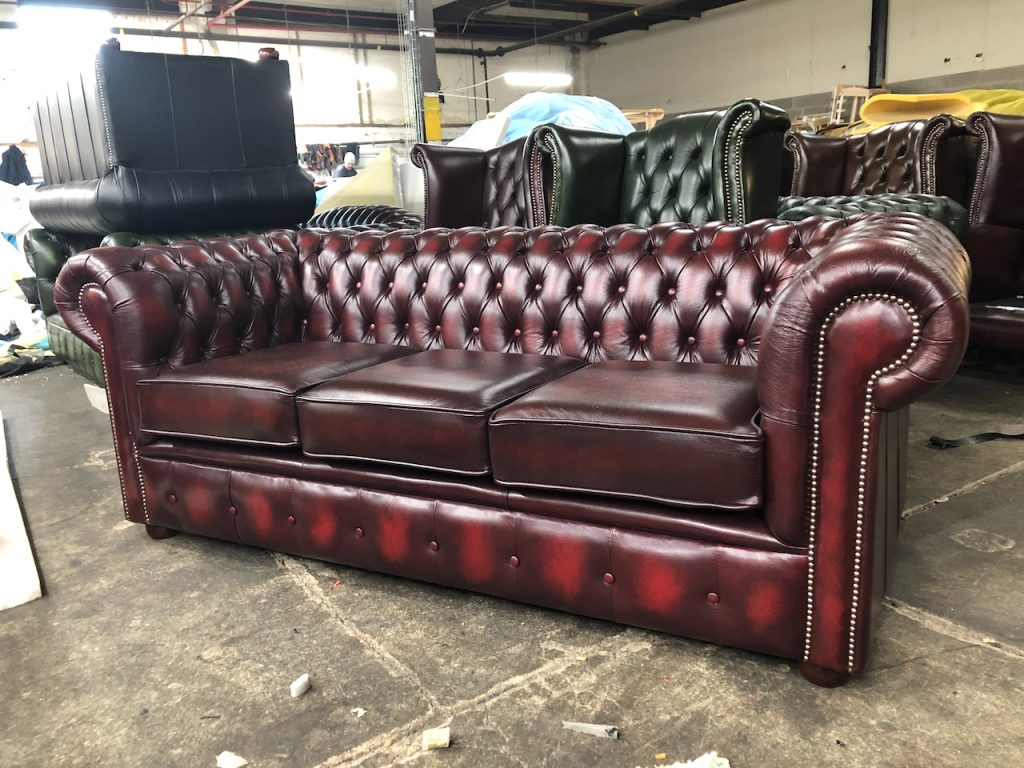
Choosing the right leather for a bespoke sofa is one of the most important decisions you will make during the buying process — and one of the most misunderstood. The leather you select determines not just how your sofa looks on day one, but how it feels, how it ages, and how long it lasts. Get it right and you have a piece that improves over decades. Get it wrong and even a well-made sofa will disappoint. When you choose leather bespoke sofa, consider the factors that affect your choice.
At Newman & Bright, our craftsmen in Worsley, Manchester have been working with the finest European leathers for years — guided by our sister company, Neumann Leathers, one of the UK’s oldest leather specialists. In this guide, we walk you through everything you need to know: the different types of leather available, what each grade means in practical terms, and how to match the right leather to your lifestyle, your home and your budget.
By the end of this guide, you will know exactly which leather is right for your bespoke sofa — and why. Free leather swatches are available at newmanandbright.co.uk so you can feel the difference before you commit.
Why Leather Quality Matters More Than You Think
Most people choose a sofa leather based on how it looks in a photograph. This is understandable — but it is also one of the most common reasons for buyer’s regret in the furniture industry.
Leather is not a single material. It is a spectrum. At one end, full-grain aniline leather is the closest thing to raw, natural hide — rich, breathable, and magnificent in the way it ages. At the other, bonded leather is made from ground-up leather fibres glued onto a fabric backing — it looks acceptable initially and deteriorates rapidly, often cracking and peeling within three to five years.
The grade of leather determines its breathability, its durability, how it responds to light and heat, how it develops over time, and how easily it can be maintained. Understanding the grades before you choose is the difference between a sofa that gets better every year and one that disappoints within months.
The 5 Main Types of Leather for Sofas — Explained
Here is a clear breakdown of every leather grade you are likely to encounter when choosing a bespoke sofa, from the most natural to the most processed.
1. Full-Grain Aniline Leather — The Finest Grade
Full-grain aniline leather is the highest quality leather available for upholstery. It is made from the top layer of the hide — the part with the tightest grain structure — and dyed with aniline dyes that penetrate the leather without coating or covering the surface.
This means the natural markings of the hide remain visible: the grain variations, the occasional small scar or insect bite, the slight differences in texture across the surface. Far from being imperfections, these are the marks of a genuine natural material — and they give the leather its extraordinary character.
- Breathes naturally — warm in winter, cool in summer
- Develops a rich patina over time — gets more beautiful with age
- The most luxurious feel of any leather grade
- Requires the most care — more susceptible to staining without conditioning
- Best for: drawing rooms, studies, low-traffic formal settings, period homes
Full-grain aniline leather is the choice of discerning buyers who want a sofa that looks better at 20 years than it did on delivery day. Newman & Bright source full-grain hides from the best tanneries in Europe through Neumann Leathers.
2. Semi-Aniline Leather — The Best of Both Worlds
Semi-aniline leather starts with the same quality hide as full-grain aniline, but receives a light protective coating on the surface. This coating is thin enough to preserve most of the natural character of the leather — the grain, the texture, the feel — while adding a degree of resistance to staining and fading that pure aniline leather does not have.
- Natural appearance with improved practical performance
- More consistent colour than pure aniline — slight surface uniformity
- Easier to maintain — more forgiving with spills
- Still develops a patina over time, though more gradually
- Best for: family living rooms, regular-use sofas, buyers who want quality with practicality
Semi-aniline is often the recommendation for buyers who love the look and feel of aniline leather but live in a household where the sofa will see daily family use. It is a genuinely excellent grade that offers very little compromise.
3. Protected (Corrected-Grain) Leather — Practical and Durable
Protected leather — also called corrected-grain or pigmented leather — goes through a more significant finishing process. The surface of the hide is buffed or sanded to remove natural imperfections, then coated with a polymer or pigment layer that creates a uniform, consistent appearance.
- Highly consistent colour and texture — no natural variation
- Most resistant to staining, fading and everyday wear
- Easiest to clean — most spills wipe off with a damp cloth
- Does not breathe as naturally as aniline grades
- Does not develop a patina in the same way
- Best for: high-traffic living rooms, households with children or pets, commercial settings
Protected leather is the practical choice — and there is absolutely nothing wrong with that. In a busy family home or a commercial environment, the priority is a leather that looks good, cleans easily and maintains its appearance under sustained use. Protected leather excels at all three.
4. Italian Leather — A Heritage of Excellence
Italian leather is not a grade in itself — it is a provenance. The tanneries of Tuscany, many of which have been operating for centuries, are recognised worldwide for the quality and consistency of their hides. The Conceria Walpier, Badalassi Carlo and other heritage tanneries produce leather with a depth of colour, a suppleness of hand, and a consistency of finish that is genuinely unmatched.
Newman & Bright’s Italian Collection draws on these heritage leathers — bringing Tuscan tanning tradition together with British handmade craftsmanship. The result is a range of sofas that feel at home in both contemporary and traditional interiors, with a quality that is immediately apparent when you sit down.
When a sofa is described as ‘Italian leather’, always ask which tannery. Genuine Italian leather from a named Tuscan tannery is a mark of quality. Generic ‘Italian leather’ can mean very little without that provenance.
5. Bonded Leather — What to Avoid
Bonded leather deserves its own entry — not because it is a quality option, but because it is frequently presented as one and needs to be clearly identified.
Bonded leather is manufactured by grinding leftover leather scraps into a fibre, mixing them with a bonding agent, and pressing them onto a polyurethane or fabric backing. The surface is then embossed and coated to mimic the appearance of natural leather. It looks convincing in photographs and in showroom lighting. Within two to four years, the coating begins to crack and peel, revealing the substrate beneath.
The presence of bonded leather in a sofa is almost always concealed. Look out for terms such as ‘genuine leather’, ‘reconstituted leather’, ‘faux leather’, or ‘PU leather’. None of these are real leather in any meaningful sense. If a leather sofa is priced significantly below what genuine leather commands, bonded leather is likely the reason why.
Newman & Bright use no bonded leather. Every hide used in their workshop is a genuine, traceable leather hide from a named European source.
How to Choose the Right Leather for Your Lifestyle — A Step-by-Step Guide
Choosing the right leather for a bespoke sofa is partly about quality and partly about matching the material to how you live. Here is a practical framework for making the right decision.
Step 1 — Consider Who Will Use the Sofa
A sofa in a formal drawing room that is used occasionally by adults can accommodate the most delicate aniline leathers. A sofa in a family living room, used daily by children, dogs and everyone else, needs a grade that can handle that reality without deteriorating.
- Adults only, occasional use → Full-grain aniline
- Adults, regular daily use → Semi-aniline
- Families with children or pets → Protected / corrected-grain
- Commercial or hospitality settings → Protected, contract-grade leather
Step 2 — Think About Colour and How It Will Age
Lighter leathers — cream, tan, natural — show the natural character of the hide most beautifully, but also show marks more readily in the early years before a patina develops. Darker leathers — black, chocolate, navy — are more forgiving day-to-day but develop less visible patina over time.
The rule that most of our craftsmen apply: if you love the natural look of leather and want a sofa that ages into something extraordinary, choose an aniline or semi-aniline in a warm, natural tone. If consistency and easy maintenance are priorities, choose a protected leather in a colour that works with your interior scheme.
Step 3 — Request Swatches and Assess Them at Home
This step is non-negotiable. Leather looks dramatically different under showroom lighting compared to the natural light in your home. A colour that appears to be a warm cognac under halogen lighting may read cooler and greyer in north-facing daylight.
Newman & Bright dispatch free leather swatches on request. Place them in your room, in the position where your sofa will sit, at different times of day. Live with the swatches for 24 to 48 hours before deciding. This single step eliminates the most common source of dissatisfaction in the leather buying process.
Step 4 — Think About Your Other Finishes
Leather does not exist in isolation. It sits alongside your flooring, your walls, your curtains and your other furniture. A deep Chesterfield in antique tan leather reads very differently against light oak flooring than against dark parquet or slate tile.
As a general guide: warm-toned leathers — tan, cognac, terracotta, rosso — work with warm interior schemes and natural materials. Cool-toned leathers — black, navy, slate grey, cobalt — work with contemporary interiors, concrete, glass and metal finishes. Neutral leathers — cream, bark, mink — are the most versatile and work across a wide range of interior styles.
Step 5 — Factor In the Style of Sofa
The leather should complement the style of the sofa. A Chesterfield is traditionally associated with antique or vintage leathers — tan, brown, dark green, oxblood — that echo its period character. An Art Deco design from the Newman & Bright collection can handle bolder, more contemporary choices — cobalt blue, mustard, or a rich jewel tone. An Italian leather contemporary sofa typically works best with cleaner, more uniform leathers in neutral or sophisticated tones.
Our craftsmen are always available to discuss which leather grades and colours work best with specific models — call us on 0161 667 9560 or visit the showroom by appointment.
How to Choose Leather Bespoke Sofa
How to Care for Your Leather Sofa — Expert Tips from Our Workshop
The longevity of any leather sofa is determined by two things: the quality of its construction, and the consistency of its care. Even the finest full-grain aniline leather will deteriorate if neglected. Even a protected leather will last far longer with regular attention.
Here are the care principles that our craftsmen recommend to every customer:
- Blot spills immediately — never rub. Use a clean, dry cloth and work from the outside of the spill inward. Rubbing spreads the liquid and can damage the surface finish permanently.
- Condition every 6 to 12 months. Leather is skin — it needs moisture to remain supple. A quality leather conditioner, applied with a soft cloth in circular motions, prevents cracking and keeps the hide looking rich. Leather care experts recommend avoiding products containing silicone, which can cause long-term surface damage.
- Keep away from heat and direct sunlight. Radiators and south-facing windows are the two most common causes of leather deterioration. Allow at least 30cm between the sofa and any heat source.
- Wipe down weekly. Dust, skin oils and daily wear build up on the surface. A lightly damp microfibre cloth, buffed dry immediately, keeps the finish in excellent condition.
- Rotate and plump cushions monthly. Even wear extends the life of both the leather and the filling beneath it.
- Use only the correct products for your leather grade. Aniline leather requires different care products to protected leather. Applying the wrong product can cause irreversible damage. Newman & Bright provide a free Leather & Fabric Care Guide to every customer — available to download at newmanandbright.co.uk.
Why Newman & Bright — And How to Get Started
Newman & Bright’s access to premium leather through Neumann Leathers — one of the UK’s oldest and most experienced leather specialists — gives their customers a genuine advantage. Most furniture retailers work with a limited range of standard catalogue leathers. Newman & Bright can source from across the best European tanneries, in a wider range of grades, colours and finishes, with the knowledge to help you make the right choice for your specific sofa and setting.
Every Newman & Bright sofa comes with a complimentary five-year warranty covering manufacturing defects and accidental damage — underwritten by major insurers. This warranty applies regardless of which leather grade you choose.
- Free leather swatches dispatched on request — see the quality in your own home
- Phone, Zoom and showroom consultations available — speak to someone who knows the product
- Bespoke sizing on every model — width, depth, height and arm style all adjustable
- 0% finance available — spread the cost without paying more
- Two-person white glove delivery across the UK
To order your free swatch pack, browse the full leather range or book a consultation — visit newmanandbright.co.uk or call 0161 667 9560. The showroom in Worsley, Manchester is open by appointment.
The right leather makes a handmade sofa exceptional. The wrong one makes even the best craftsmanship a disappointment. Take the time to choose well — and if you need guidance, our team is here to help.
Frequently Asked Questions — Choosing Leather for a Bespoke Sofa
What is the best leather for a bespoke sofa?
The best leather depends on how the sofa will be used. For a formal or occasional-use setting, full-grain aniline leather offers the finest quality and develops the most beautiful patina over time. For a family home with daily use, semi-aniline provides an excellent balance of quality and practicality. For households with children or pets, or for commercial settings, protected (corrected-grain) leather offers the best durability and ease of maintenance.
What is the difference between aniline and semi-aniline leather?
Aniline leather is dyed with transparent dyes that penetrate the hide without coating the surface, preserving all the natural character of the leather. Semi-aniline leather receives an additional light protective coating that reduces staining susceptibility while retaining most of the natural look and feel. Semi-aniline is more practical for everyday use; aniline is more luxurious but requires more care.
Is Italian leather better than other leather?
Italian leather refers to leather tanned in Italy — predominantly in the Tuscany region — using traditional tanning methods developed over centuries. The quality of Italian leather is generally very high, owing to the expertise of the tanneries and the quality of the hides they source. However, ‘Italian leather’ is not a protected term, so it is important to ask which specific tannery the leather comes from. Newman & Bright source from named Tuscan tanneries with verified provenance.
How can I tell if a sofa uses bonded leather?
Bonded leather is often described using terms like ‘genuine leather’, ‘reconstituted leather’, ‘PU leather’ or ‘faux leather’. If a leather sofa is priced significantly below what genuine leather commands — typically below £500 for a two-seater — bonded leather is likely the reason. Bonded leather also tends to feel uniform and slightly plastic to the touch, lacking the natural variations in texture that real leather exhibits.
How often should I condition a leather sofa?
Most leather care specialists recommend conditioning a leather sofa every six to twelve months, depending on the grade of leather and the amount of sunlight or heat it is exposed to. Sofas in rooms with significant direct sunlight may benefit from conditioning every four to six months. Full-grain aniline leather should be conditioned more frequently than protected leather, as it has no surface coating to retain moisture.
Can I get free leather swatches from Newman & Bright?
Yes. Newman & Bright dispatch free leather swatch packs on request, allowing you to assess the colour, texture and quality of the leather in your own home, under your own lighting conditions, before placing an order. Swatches are available at newmanandbright.co.uk or by calling 0161 667 9560.
How long does a leather sofa last?
A genuine leather sofa, made with quality construction and properly maintained, can last 20 to 30 years. Full-grain aniline and semi-aniline leathers actually improve in character over time, developing a rich patina. In contrast, bonded leather typically begins to crack and peel within three to five years. Newman & Bright include a complimentary five-year warranty on every sofa, covering both manufacturing defects and accidental damage.
Final Thoughts — Choosing Leather Is Choosing the Future of Your Sofa
Choosing the right leather for a bespoke sofa is not a decision to make quickly or based on a screen image alone. It is a decision about how you want to live with a significant piece of furniture for the next 20 to 30 years.
The good news is that the choice becomes straightforward once you understand the grades, consider your lifestyle honestly, and take the time to assess real swatches in your own home. The team at Newman & Bright have guided hundreds of customers through this decision — and we are here to help you make the right one.
Browse our full leather range at newmanandbright.co.uk, request your free swatch pack, or call us directly on 0161 667 9560. Our Chesterfield collection, Art Deco collection, and Italian leather range each lend themselves to different leather grades — and we are happy to advise on the best match for any model.
Your sofa should be exactly right. The leather is where that begins.
Do’s & Don’ts of Leather Sofa Maintenance (Avoid Cracks & Fading!) By BLIMS